I'm not exactly sure why I was able to sail one good race and follow it with two bad races. They weren't that different, although the mode of sailing in the waves changed a tiny bit I think.
In the first race I started near the boat end, found a clear lane heading right, and sailed fast. I was focusing hard on constant angle of heel and found a nice slow rhythm of leaning against the pressure in the sail as I sailed up a wave, then leaning in to ride the bow down the back side. I took one or two little hitches in when I felt knocked on port, but otherwise went to lay line from pretty far out because I felt I was in good pressure in my corner. I over stood a little bit, but rounded in 4th and managed to hold on to it. Since the waves were pushing us pretty hard to the right downwind, and it was very light wind, I stayed hard by the lee on starboard on the down winds and did not get passed.
In the second race, I tried to do the same thing, but finding a clear lane was much harder, and I don't think I had the same speed. Downwind I was losing a bit here and there and I'm not sure why. I never found the same smooth rhythm either upwind or downwind for the rest of the day. I'm sure it didn't help that when I felt uncertain about what the fastest mode was, I spent time trying different things to find it.
Thursday, March 3, 2016

Wednesday, March 2, 2016
no racing today
We never got quite enough win today to hold a race. I was looking forward to practicing my light air big wave technique, and I did get some practice in while we were waiting around on the water. Racing was going to be very unusual in those conditions. I practiced focusing on constant angle of heel. Hopefully we will race tomorrow.
Tuesday, March 1, 2016
It is very discouraging to finish almost last in every race of a day. There is no doubt about that. Also no doubt that my speed today was slow. The conditions today were tough as usual - big 2.4 meter high fast moving waves with about 8 to 12 knots of wind. The apparent wind was all over the place - hiking or leaning out - then scooting into the boat - then back out again for every wave. Although I have spent time sailing in waves this big, this apparent wind adjustment in these conditions is not something I have mastered.
I am trying to keep in mind that my own improvement is impossible to measure against a fleet of sailors who are putting more time and money than I am into this sport. I look around at the people I am sailing against they just look like a bunch of regular teenagers - what could they possibly know that I don't? But they aren't regular teenagers, they are the ones who started early, excelled, and are supported by their families and national sports federation, and they are able to devote more time than I am. So what do I expect? To improve faster than they do? On days like today it can feel like I have simply gotten worse at sailing over the last couple years, but it might just be that I am actually improving, just not as fast as this international crowd.
So tomorrow is another day. 2 races. The goal is first to nail 2 good starts - which means focusing on the details of the start. Second, try to focus on speed and always maintaing constant heel, perfect sail trim, and not stalling the blades. It's hard to sail head of the boat and do this at the same time of course.
Here is a link to pics from the first day:
https://www.flickr.com/photos/eventosnauticosrcngc/
Here is a link to pics from the first day:
https://www.flickr.com/photos/eventosnauticosrcngc/
Monday, February 29, 2016
Day two - first day of racing
We had three races today in 15-20 knots I think. The waves were huge and fast, and a bit sideways. Most of our surfing was done on the top reach, going with the waves.
I am exhausted - got cold while we waited for a squall to roll through before starting the last race, and then it took over an hour to sail back to the yacht club.
The day was squally there were pretty big shifts, but it was sometimes hard to tell which squall was going to dominate the beat since there were often just windy rain clouds everywhere. Sometimes it was obvious, but after the second beat of the first race, I realized that the shift from the squall didn't come until you were practically under the cloud. Paige said she was surprised by the same phenomenon.
Everything about the day seemed hard. I never felt particularly fast in any direction, upwind on port was head on into very big waves, and on starboard they would roll under you sideways and sometimes they would push you sideways so your sail luffed.
Downwind was very hard because you could reach on starboard and catch a wave, but doing that more than a few times would send you off the course completely. By the end of the day I think I had a slightly better grasp on how to sail downwind. I found that it seemed good to sail hard by the lee on starboard, and as a started to push you, you could head down the wave for just a second to get some speed, then turn back by the lee and let the wave roll under you. This way you were never surfing waves completely, but using them to get a little speed and take it back by the lee to get towards the mark.
Three more races tomorrow probably, the forecast is similar, but dying in the afternoon. My goal is first to get to the line earlier when there is more space and execute better starts. I didn't have any good starts today, and I think I was getting to the line a little late when there were only a few or no good spaces left.
I am exhausted - got cold while we waited for a squall to roll through before starting the last race, and then it took over an hour to sail back to the yacht club.
The day was squally there were pretty big shifts, but it was sometimes hard to tell which squall was going to dominate the beat since there were often just windy rain clouds everywhere. Sometimes it was obvious, but after the second beat of the first race, I realized that the shift from the squall didn't come until you were practically under the cloud. Paige said she was surprised by the same phenomenon.
Everything about the day seemed hard. I never felt particularly fast in any direction, upwind on port was head on into very big waves, and on starboard they would roll under you sideways and sometimes they would push you sideways so your sail luffed.
Downwind was very hard because you could reach on starboard and catch a wave, but doing that more than a few times would send you off the course completely. By the end of the day I think I had a slightly better grasp on how to sail downwind. I found that it seemed good to sail hard by the lee on starboard, and as a started to push you, you could head down the wave for just a second to get some speed, then turn back by the lee and let the wave roll under you. This way you were never surfing waves completely, but using them to get a little speed and take it back by the lee to get towards the mark.
Three more races tomorrow probably, the forecast is similar, but dying in the afternoon. My goal is first to get to the line earlier when there is more space and execute better starts. I didn't have any good starts today, and I think I was getting to the line a little late when there were only a few or no good spaces left.
Sunday, February 28, 2016
day 1 Europeans
Postponed on shore for too much wind and big waves. The squalls roll through periodically and it goes from sun to rain to sun. The wind gusts are big but it it hard to tell what the conditions are out on the race course. The rumor is that the waves are too big for the race committee to set marks. Not sure what will happen, maybe we will get to race.
We did not race today. I went for a bike ride after they cancelled us to look at the conditions. The waves were definitely big, but it didn't seem that windy. Hopefully we will get to race tomorrow - the forecast is similar to today.
It was nice to get a little local weather knowledge from Robert Hopkins who lives here in Las Palmas. This is what I learned: In the summer the Canaries are in the trade winds which blow from the northeast. In the winter the prevailing wind is also from the northeast because the Azores High sits to the northwest, but the weather is dominated by frontal systems - which is what we are seeing right now. When the wind is from the north or northwest, it channels between La Isleta and the main part of the island and is accelerated along the shore, but then it fans out as the shore bends south. This morning he advised looking for the squalls and recognizing which side of the squall you were on and that the breeze would shift correspondingly, and die on the back side of the squall. As we were waiting around the velocity changes as the squalls passed by were pretty big. He also talked about the local current, which is primarily wind driven, but is affected by the shore line which creates eddies and swirls that often change during racing. He advised paying attention to clues about the current while racing to try to understand how it is affecting you at that moment.
Sails down while we wait for them to send us out:

Now everyone is packing up:

Map of course area:

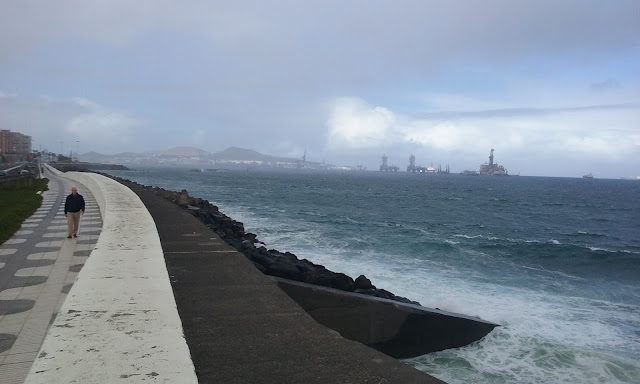
Some waves onshore near our race course:

Here you can see the next squall heading toward us from La Isleta:
The beach on the other side of the peninsula:


Mom, I figured you would take a lot of pictures of this door:

We did not race today. I went for a bike ride after they cancelled us to look at the conditions. The waves were definitely big, but it didn't seem that windy. Hopefully we will get to race tomorrow - the forecast is similar to today.
It was nice to get a little local weather knowledge from Robert Hopkins who lives here in Las Palmas. This is what I learned: In the summer the Canaries are in the trade winds which blow from the northeast. In the winter the prevailing wind is also from the northeast because the Azores High sits to the northwest, but the weather is dominated by frontal systems - which is what we are seeing right now. When the wind is from the north or northwest, it channels between La Isleta and the main part of the island and is accelerated along the shore, but then it fans out as the shore bends south. This morning he advised looking for the squalls and recognizing which side of the squall you were on and that the breeze would shift correspondingly, and die on the back side of the squall. As we were waiting around the velocity changes as the squalls passed by were pretty big. He also talked about the local current, which is primarily wind driven, but is affected by the shore line which creates eddies and swirls that often change during racing. He advised paying attention to clues about the current while racing to try to understand how it is affecting you at that moment.
Sails down while we wait for them to send us out:

Now everyone is packing up:

Map of course area:

Here you can see the next squall heading toward us from La Isleta:

The beach on the other side of the peninsula:


Mom, I figured you would take a lot of pictures of this door:
Saturday, February 27, 2016
Europeans begin tomorrow
I arrived here in Las Palmas yesterday morning and had to take 2 buses from the airport to the yacht club. In my jet lagged state, I left my wallet on the bus. I managed to track it down with the help of 4 different bus drivers who called the dispatcher and drove me to the bus station. I wasn't really awake enough to remember how to speak spanish well. It took a little bit to figure out that the bus driver was calling the dispatcher for the blue bus company and looking for my wallet on blue number 01 instead of the yellow bus number 1. Eventually they figured it out and took me to the yellow bus station and I got it back! It's a nice feeling when when you lose something valuable and it gets returned to you thanks to the good graces of strangers.
I got back to the sailing center and picked up my charter boat and all the different spars and blades and fixed the small things that needed fixing on my boat. I didn't have time to sail yesterday, but today I did after measurement and registration. About 18 knots and big waves. Similar to a big wave day at third beach, but these waves push right downwind as opposed to the left biased ones I am used to practicing in. Our course area is pretty far away, which will be fine for getting out to the racecourse for the next few days since it is downwind, but the sail home will be long. Hopefully I can snag a tow.
Racing starts tomorrow at noon, and we have six days of two races per day. Here are a few pics:
Measuring in:


The apartment where I am staying:


I got back to the sailing center and picked up my charter boat and all the different spars and blades and fixed the small things that needed fixing on my boat. I didn't have time to sail yesterday, but today I did after measurement and registration. About 18 knots and big waves. Similar to a big wave day at third beach, but these waves push right downwind as opposed to the left biased ones I am used to practicing in. Our course area is pretty far away, which will be fine for getting out to the racecourse for the next few days since it is downwind, but the sail home will be long. Hopefully I can snag a tow.
Racing starts tomorrow at noon, and we have six days of two races per day. Here are a few pics:
View of the race area from the bus:

Measuring in:


The apartment where I am staying:


Thursday, February 25, 2016
What it means to compete
When you say "She's super competitive," many of us would think you are talking about a woman who is driven by a desire to win, and can't bear to lose. But I think there is more depth to the truly competitive athlete. A true competitor is the person who values what tough competition brings out in all of us - a higher level of performance - and always seeks out the toughest competition and challenges themselves. A true competitor prefers finishing second in a tight battle that raises the level of competition to an easy win.
For me, doing an Olympic Campaign is a challenge that raises the bar and gets me closer to reaching my potential. I did not finish well in the first half of the Olympic Trials (the Miami World Cup Regatta). And I am not in a position to be in the running for our country's Olympic slot, and yet here I am in the airport on the way to the Laser Radial Europeans to compete in the second half of the Olympic Trials. Many sailors wouldn't bother competing if they felt they had no chance at winning, but I feel that it is important to do my best right up until the end of my campaign. The goal was to get to the Olympics, but the goal was also, and still is, to reach my potential, or at least get as close as I can given my resources.
I have learned a ton in the last few years, and I have definitely improved, but I don't feel like I have been able to execute everything I have learned at a big event. This regatta is my chance to put it all together. If I can put together a good event with good starts and decent speed and tactics, I will really feel like I have accomplished something. If not, it will be another learning experience. I know that competitive sailing is something that will be providing learning experiences for me for many years to come, and it is something that I look forward to.
As always, when I get to Las Palmas, I will be there to compete, to try my hardest, and to enjoy the challenge of competing against the best sailors!
I will post more regular updates when I get there, so stay tuned.
-Christine
For me, doing an Olympic Campaign is a challenge that raises the bar and gets me closer to reaching my potential. I did not finish well in the first half of the Olympic Trials (the Miami World Cup Regatta). And I am not in a position to be in the running for our country's Olympic slot, and yet here I am in the airport on the way to the Laser Radial Europeans to compete in the second half of the Olympic Trials. Many sailors wouldn't bother competing if they felt they had no chance at winning, but I feel that it is important to do my best right up until the end of my campaign. The goal was to get to the Olympics, but the goal was also, and still is, to reach my potential, or at least get as close as I can given my resources.
I have learned a ton in the last few years, and I have definitely improved, but I don't feel like I have been able to execute everything I have learned at a big event. This regatta is my chance to put it all together. If I can put together a good event with good starts and decent speed and tactics, I will really feel like I have accomplished something. If not, it will be another learning experience. I know that competitive sailing is something that will be providing learning experiences for me for many years to come, and it is something that I look forward to.
As always, when I get to Las Palmas, I will be there to compete, to try my hardest, and to enjoy the challenge of competing against the best sailors!
I will post more regular updates when I get there, so stay tuned.
-Christine
Sunday, January 31, 2016
End of Miami World Cup
Friday: After the gold fleets sailed we had three silver fleet races. A light wind from the west coming off the city was very shifty and sometimes the pressure would evaporate. It was tricky sailing to say the least. I had one mediocre race, one 2nd place, and a poor result around 30th.
All in all this has been yet another humbling, tough regatta. It is hard to stay mentally positive when my results don't reflect how much I know I have learned in the last few years. Of course a little perspective always helps and I appreciate how lucky I am to spend as much time as I have been pursuing laser sailing and competing in these elite regattas.
I also know that although my laser campaign will end pretty soon, I will continue to race lasers and pursue the answers to what to do in every situation, and practice executing what I know.
In a couple days I will sail in the Masters' week in Jensen Beach and West Palm Beach which will be a great opportunity to practice executing good reliable starts and sailing tactically conservative.
All in all this has been yet another humbling, tough regatta. It is hard to stay mentally positive when my results don't reflect how much I know I have learned in the last few years. Of course a little perspective always helps and I appreciate how lucky I am to spend as much time as I have been pursuing laser sailing and competing in these elite regattas.
I also know that although my laser campaign will end pretty soon, I will continue to race lasers and pursue the answers to what to do in every situation, and practice executing what I know.
In a couple days I will sail in the Masters' week in Jensen Beach and West Palm Beach which will be a great opportunity to practice executing good reliable starts and sailing tactically conservative.
Thursday, January 28, 2016
Deluge
It poured most of the day. Laser and Radial Gold fleets each got one race in in the late afternoon before it got dark when the rain abated and the wind picked up. They go first again tomorrow, but hopefully the wind and weather will allow good racing so they can get 3 races off, and we still have time for 3 races.
Wednesday, January 27, 2016
Finally we have had some racing
Tuesday:
Although yesterdays forecast was for 15 knots, the beautiful breeze that was there in the morning died to nothing. We were eventually moved from our course area to one closer to shore that had more wind and we were able to get one race off in about 5 knots of wind and strong side current. I thought the right side seemed better and started at the boat but was a bit late. I was able to get a clear lane out to the right side of the course, but the left came in and I was in the back of the fleet at the windward mark. I was able to make some small gains on the downwind and next upwind by staying on the edge, and the right side was better on the second upwind. I was not too disappointed with a result in the high 20's in that kind of wind.
Today Wednesday:
We had three races today. The forecast was for squalls to move through the area, but we didn't see any squalls, just clouds and haze. The wind was pretty steady from the SE at about 6-10 knots.
Race 1: I backed out of my spot on the starting line when I was getting too close to the boat to leeward of me. I was thinking that I would back out and then go back in to the same space, but I didn't have enough time, so I ended up starting on port ducking starboard tackers. I had seen pressure up the course on the right side so heading that way was good I thought. We were just leaning out, not hiking (about 6 or 7 knots?) in chop. I got to the pressure, but the wind slowly shifted left never shifted back. The whole fleet got wound up inside of me and I rounded the windward mark in last. The breeze stayed at that new angle for the rest of the race and I was only able to pass one boat.
Race 2: I had a great start and was able to hold my lane most of the way up the beat. Yay! We were occasionally hiking (8 or 9 knots I guess?) At some point near the top of the beat I had trouble holding my lane and started dropping sideways. I'm not sure why. There were a lot of weeds on the course, so I cleared my daggerboard, but was still struggling. I think the pressure may have dropped a little. I lost at the top of the beat when everyone converges and the lanes disappear and there is no clear air. Then I lost a little bit more here and there all the way around the course. The downwind was tough and I may have zig zagged too much.
Race 3: Another good start middle boat end. In this race we were hiking on the first beat although it wasn't windy enough for the boat to feel lively. It was that slow, loaded feeling of hiking. I held my lane, was fast forward and was fifth at the windward mark. Held my spot on the reach, and only lost a few boats on the run. The second upwind was lighter, no hiking, but my boat speed was okay and there were a couple minor shifts and pressure changes that I think I played well so that I didn't lose boats on the upwind. The second downwind as I tried to defend the left side (since we round the last mark to port before reaching to the finish) a pack of boats was catching me. We were by the lee on starboard, and I was afraid they would pass me. I reached in front of them to get to the right where there was clear air, gybed to port, sailed by the lee, gybed back and sailed by the lee back to the mark and I was still ahead of all of them, including the really fast danish girl! I finished 13th and was really proud of that result in those conditions.
Unfortunatley, it is not possible to overcome results in the 30s and a BFD to make gold fleet. I am far back in the pack realizing that my boat speed upwind and downwind are still not good enough in these conditions. (Light and choppy) I think that I have improved in these conditions in the past couple years, but the people I am racing against here (and at the worlds) have improved faster.
Although yesterdays forecast was for 15 knots, the beautiful breeze that was there in the morning died to nothing. We were eventually moved from our course area to one closer to shore that had more wind and we were able to get one race off in about 5 knots of wind and strong side current. I thought the right side seemed better and started at the boat but was a bit late. I was able to get a clear lane out to the right side of the course, but the left came in and I was in the back of the fleet at the windward mark. I was able to make some small gains on the downwind and next upwind by staying on the edge, and the right side was better on the second upwind. I was not too disappointed with a result in the high 20's in that kind of wind.
Today Wednesday:
We had three races today. The forecast was for squalls to move through the area, but we didn't see any squalls, just clouds and haze. The wind was pretty steady from the SE at about 6-10 knots.
Race 1: I backed out of my spot on the starting line when I was getting too close to the boat to leeward of me. I was thinking that I would back out and then go back in to the same space, but I didn't have enough time, so I ended up starting on port ducking starboard tackers. I had seen pressure up the course on the right side so heading that way was good I thought. We were just leaning out, not hiking (about 6 or 7 knots?) in chop. I got to the pressure, but the wind slowly shifted left never shifted back. The whole fleet got wound up inside of me and I rounded the windward mark in last. The breeze stayed at that new angle for the rest of the race and I was only able to pass one boat.
Race 2: I had a great start and was able to hold my lane most of the way up the beat. Yay! We were occasionally hiking (8 or 9 knots I guess?) At some point near the top of the beat I had trouble holding my lane and started dropping sideways. I'm not sure why. There were a lot of weeds on the course, so I cleared my daggerboard, but was still struggling. I think the pressure may have dropped a little. I lost at the top of the beat when everyone converges and the lanes disappear and there is no clear air. Then I lost a little bit more here and there all the way around the course. The downwind was tough and I may have zig zagged too much.
Race 3: Another good start middle boat end. In this race we were hiking on the first beat although it wasn't windy enough for the boat to feel lively. It was that slow, loaded feeling of hiking. I held my lane, was fast forward and was fifth at the windward mark. Held my spot on the reach, and only lost a few boats on the run. The second upwind was lighter, no hiking, but my boat speed was okay and there were a couple minor shifts and pressure changes that I think I played well so that I didn't lose boats on the upwind. The second downwind as I tried to defend the left side (since we round the last mark to port before reaching to the finish) a pack of boats was catching me. We were by the lee on starboard, and I was afraid they would pass me. I reached in front of them to get to the right where there was clear air, gybed to port, sailed by the lee, gybed back and sailed by the lee back to the mark and I was still ahead of all of them, including the really fast danish girl! I finished 13th and was really proud of that result in those conditions.
Unfortunatley, it is not possible to overcome results in the 30s and a BFD to make gold fleet. I am far back in the pack realizing that my boat speed upwind and downwind are still not good enough in these conditions. (Light and choppy) I think that I have improved in these conditions in the past couple years, but the people I am racing against here (and at the worlds) have improved faster.
Monday, January 25, 2016
Day one in Miami
I'm sorry everyone for being an idiot today and letting myself get pushed over the line early on a black flag start. It is little consolation to know that many others in my fleet were also called over since I made some big mistakes that led to being one of the boats blatantly over the line.
Here the thoughts about starting that are running through my brain this evening:
Here the thoughts about starting that are running through my brain this evening:
- Be a bully - on the starting line you are no one's friend. Never be nice and always be selfish, and be vocal boss people around and tell them what to do if they are threatening you
- On a black flag - don't be one of the boats closer to the line than others - stay hidden
- Know your moves to defend your space and if someone comes in to leeward too close to you, head up hard and hit them with your transom corner while you are avoiding them
- If your space to leeward on the line is too big, sail down to the boat next to you to make it smaller and less enticing for someone to go there - this helps you to control your space better
Thats it - I could berate myself all night for starting off the regatta with a black flag, but tomorrow is a new day. I've got the mantra of 'make everything count' for the rest of the regatta.
Today's events: We were postponed on shore for quite a while waiting for the wind to fill back in from the east. It had started as a light northwesterly breeze in the morning, then died after the boys sailed their first race. We waited on shore and they waited on the water, and by the time they sent us out, it had started to fill from the east, but was still pretty unstable. I watched the start of the boys blue and yellow fleets second race, and the radial blue fleet. There was quite a bit of current going upwind and left. Our starts were pin favored, the first was a general recall on a U flag, and the second was a general recall on a black flag. Almost half our fleet was called over and after sailing by the signal boat and seeing our sail numbers written on the board, everyone who was scored BFD towed home. By this time it was about 5pm. I stayed out to watch the rest of our puny fleet start and sail the first beat. The wind had picked up to maybe 9 or 10 knots, and most of the fleet was hiking. I was very sorry to have missed this race - not getting to compete is the worst!
Pics from today waiting around:


Pics from today waiting around:


Curry for dinner! - Thanks Michelle
Sunday, January 24, 2016
Update - Olympic Trials Begin
I have been in Miami for a few days now, warming up for the start of the Miami World Cup Regatta. Racing begins tomorrow and this is the first of two regattas that combined will make up the Olympic Trials. The weather in Florida for the past two weeks (I was in Ft Lauderdale prior to Miami) has been very stormy and changeable. Each day a different direction, with some big wind and rain storms. I had a short practice yesterday with Lindsey Baab when most sailors weren't sailing due to too much wind. It was good to get out and sail, although we both bent mast sections. It is frustrating to know that you are likely to be bending either top or bottom sections when it is windy! I have already bent two bottoms since I have been here in Florida.
The format for the regatta consists of two races per day for six days. In the first three days our 80 boat fleet is divided into two even fleets, blue and yellow (based on ranking or current standing in the regatta). After three days we are split into the top and bottom halves called gold and silver.
The forecast seems to be steadying out a little bit with medium winds from the east clocking around to the SE over the next few days.
I'll send out updates as the regatta progresses, we have 18 Americans in the Women's Radial fleet. I hoping to be in the top five, but as is always the case, racing involves executing one thing at a time. It starts with the start!
The format for the regatta consists of two races per day for six days. In the first three days our 80 boat fleet is divided into two even fleets, blue and yellow (based on ranking or current standing in the regatta). After three days we are split into the top and bottom halves called gold and silver.
The forecast seems to be steadying out a little bit with medium winds from the east clocking around to the SE over the next few days.
I'll send out updates as the regatta progresses, we have 18 Americans in the Women's Radial fleet. I hoping to be in the top five, but as is always the case, racing involves executing one thing at a time. It starts with the start!
Thursday, January 21, 2016
Lauderdale summary
The Lauderdale OCR (a qualifier for Miami World Cup) was one of the weirdest regattas I have ever sailed. I have to give props to the race committee for being determined to run races in all conditions.
The first day was extremely light and unpredictable, with waves of wind and shifts coming from both sides. I determined that getting to an edge was very important, but how to commit to the correct side? In two races I called it wrong on the first beat and right on the second beat and had two top ten finishes. I was very happy with those results. In the second race I guessed that the right side was more reliable than the left and although it didn't pay in the first leg, I stuck to my guns and committed hard to that side all the way through the race. It payed off in the end. It was one of those times where it seemed to make sense to minimize your chances of getting every leg wrong by switching sides each leg.
Day two was one of the windiest days of racing I have had. Twenty plus knots of westerly offshore wind with gusts to 30. The shifts were very big and the wind was unstable coming off the land. We also had leftover swell from the southeast, which was interesting. Upwind we were surfing on port tack, but on starboard the swell was rolling under you. Downwind there was no wave surfing, although you could turn up to use a swell to get planing if you were in a lull and then turn back down sailing along the troughs of the waves and sometimes jumping over the swell sideways to the next trough.
Day three was just tricky and unpredictable. medium to light NW wind at an oblique angle to the beach meant that sometimes heading to the beach for pressure was good, but sometimes not. It seemed like the kind of day where you wanted to be sailing to pressure and staying on the lifted tack, which seems like an easy formula. It always seemed like nothing worked. I found myself confused and didn't know where to go most of the time. In talking to other sailors about this day, I have learned that it was just so weird I should ignore it, no one knew what to do. I think that is a condition I will file away in my head and continue to try to figure out over the years. Perhaps I needed to understand better what was happening with the weather? Or maybe it was the kind of random day where you sail the lifted tack even if it seems to be taking you away from pressure since the pressure won't be there when you get there.
All in all I finished 7th and was the top american woman. Mostly I was happy with my ability to sail well on the first and second days, feeling like my speed and decision making was pretty good compared to some top international sailors in those conditions.
The first day was extremely light and unpredictable, with waves of wind and shifts coming from both sides. I determined that getting to an edge was very important, but how to commit to the correct side? In two races I called it wrong on the first beat and right on the second beat and had two top ten finishes. I was very happy with those results. In the second race I guessed that the right side was more reliable than the left and although it didn't pay in the first leg, I stuck to my guns and committed hard to that side all the way through the race. It payed off in the end. It was one of those times where it seemed to make sense to minimize your chances of getting every leg wrong by switching sides each leg.
Day two was one of the windiest days of racing I have had. Twenty plus knots of westerly offshore wind with gusts to 30. The shifts were very big and the wind was unstable coming off the land. We also had leftover swell from the southeast, which was interesting. Upwind we were surfing on port tack, but on starboard the swell was rolling under you. Downwind there was no wave surfing, although you could turn up to use a swell to get planing if you were in a lull and then turn back down sailing along the troughs of the waves and sometimes jumping over the swell sideways to the next trough.
Day three was just tricky and unpredictable. medium to light NW wind at an oblique angle to the beach meant that sometimes heading to the beach for pressure was good, but sometimes not. It seemed like the kind of day where you wanted to be sailing to pressure and staying on the lifted tack, which seems like an easy formula. It always seemed like nothing worked. I found myself confused and didn't know where to go most of the time. In talking to other sailors about this day, I have learned that it was just so weird I should ignore it, no one knew what to do. I think that is a condition I will file away in my head and continue to try to figure out over the years. Perhaps I needed to understand better what was happening with the weather? Or maybe it was the kind of random day where you sail the lifted tack even if it seems to be taking you away from pressure since the pressure won't be there when you get there.
All in all I finished 7th and was the top american woman. Mostly I was happy with my ability to sail well on the first and second days, feeling like my speed and decision making was pretty good compared to some top international sailors in those conditions.
Wednesday, January 13, 2016
Ft Lauderdale
It's great to be in Florida so I can focus full time on sailing! I just arrived today from Rhode island. It takes 24 hrs of driving, so I stopped to sleep twice, and arrived today in time to unload, put together my boat and go for a sail.
If you have never sailed from Lauderdale Yacht Club you are missing out. The ocean venue can produce every type of condition. Today we had a kind of variable NE wind 5-15 knots I guess? Although I was not out for too long since I had to catch a ride in with some other sailors. The sail from the club to the ocean and back is long! You do not want to be left out there when the wind is dying and the tide is going out because you might not make it back for a long time.
The Lauderdale Olympic Classes Regatta begins on Saturday, and we have 3 days of racing - Saturday-Monday. Technically it is a qualifier for the Americans for Miami World Cup Regatta. There are enough slots at the MWCR for americans that most of us trying to get a slot at this event will get one, but completely blowing the regatta is not an option. The forecast is for a front to move through in the next couple days, followed by light wind on Saturday. We will see what happens!
If you have never sailed from Lauderdale Yacht Club you are missing out. The ocean venue can produce every type of condition. Today we had a kind of variable NE wind 5-15 knots I guess? Although I was not out for too long since I had to catch a ride in with some other sailors. The sail from the club to the ocean and back is long! You do not want to be left out there when the wind is dying and the tide is going out because you might not make it back for a long time.
The Lauderdale Olympic Classes Regatta begins on Saturday, and we have 3 days of racing - Saturday-Monday. Technically it is a qualifier for the Americans for Miami World Cup Regatta. There are enough slots at the MWCR for americans that most of us trying to get a slot at this event will get one, but completely blowing the regatta is not an option. The forecast is for a front to move through in the next couple days, followed by light wind on Saturday. We will see what happens!
Saturday, December 19, 2015
Newport's One-of-a-kind Christine Neville
Winter Issue of The Laser Sailor, By Joe Berkeley

Campaigning for the Olympic games in the Laser at the age of 35 is not a common choice. But Christine Neville is an uncommon woman.
Her mother Susan Neville said, “I could count on Christine to push the limits as a child. She was the kid who made her teachers nervous and her coaches proud. She’s not one to follow others. She is always finding a new path to explore.”
Christine stands just shy of six feet tall. She is a lean, rangy athlete with piercing blue eyes, a quick smile, a blonde ponytail and a wingspan of 5’ 11” from fingertip to fingertip. But it’s her hands that set her apart.
Christine has strong, quick hands and she has used them to learn how to build sails, weld metal, do finish carpentry, craft a long board, repair boats and rig yachts. And that’s just for starters.
Bill Fastiggi of Vermont Sailing Partners noted that Christine is the only woman he has ever met who owned a Saab for her primary car as well as a Saab parts car to keep it running. When her red Saab 900 broke down, and it broke down frequently, she took it apart and put it back together herself.
When Christine moved out west, Fastiggi watched as she built a trailer from spare parts to transport all of her possessions across the country. Identifying a problem and improvising a solution is something Christine has been doing all her life. Fastiggi recalled that when Christine had a 20-mile commute and limited resources, she economized by outfitting a bicycle she found with a 32 cc, one-piston motor kit she purchased for less than $100 on eBay. The motorbike was supremely dodgy, unsafe at any speed, especially its 30-mile-per-hour maximum velocity, but it propelled Christine to and from work for a summer.
Her personal engine may well be more powerful than the motorized contraption. Many cyclists train for a year before attempting to ride 100 miles, which in cycling terms is known as a “century.” Christine thought that sounded like a cool idea, riding 100 miles, so she did it without any training on a bike she borrowed from Lindy Kelly that was two sizes too small.
Her best friend Rois Langner says Christine has a “no-big-deal – I got this” attitude that makes her capable of many things, if not anything: fixing old cars, sewing ski-packs, making canvas covers for her Laser, backpacking in the wilderness, traveling around the world, sailing Lasers, and now being a strong contender for the 2016 Summer Olympics.
As a teenager, she spent hours rigging and re-rigging a chartered C-scow so that she could race it with her friend Mary Chamberlin. Mary recalled, “We dumped the boat repeatedly, even sunk it once or twice, but Christine always stayed calm and handled the situation. She would come back after racing and dissect the race; did we have our heads out of the boat? Could the rigging be tweaked? Why did that board get stuck? How was our start?”
For Christine, sailing fast has always been more important than living comfortably. Mary noted, “Christine moved between house sitting gigs, the lodge of Cochran's ski area, and a van while wind surfing at Hood River.” For Christine, sailing is a necessity. Electricity and running water are luxuries.
Many dream of living in a mansion. At one point, Christine’s dream home was a yurt, a semi-permanent but movable structure because it would enable her to do what she loved most.
All of that sailing, clean living and outdoor activity has given Christine exceptional fitness and when she suits up at Laser radial regattas, 17-year-old boys stop and stare slack jawed at her jacked biceps and think, “Whoa, I gotta hit the gym.”
Her fitness is not for show. In the boat, there is a fast-twitch-muscle pop to all of her motions. Christine trims the vang with a sharp snap, roll tacks with controlled violence, and hikes the boat flat with bursts of power. Before she was a dedicated Laser sailor, Christine crewed in the 49erFX class, a skiff. Her skipper, Kristen Lane said, “She physically attacks sailing. She's been blessed with an extremely athletic body. But she is one of the hardest working people I know. There was never ever a day when Christine didn't want to go rip it up in the skiff. Even days when I thought it was too much, Christine was dressed, ready, looking at me like - get your ass on this boat!”
At the European 49erFX Championship, there was a contest on land to see which crew could hoist a spinnaker fastest. Christine blew away the competition with a time of 2.9 seconds. Her skipper thought about removing the video from Facebook because she feared a Volvo Ocean Race team would recruit her.
 Optimism and forward thinking are part of Christine’s DNA and she has very few regrets. One of them is not trying out for the Volvo Ocean Race all-female boat, Team SCA. With her quick hands, high power to weight ratio, sunny disposition and sail maker’s background, she could have been a strong addition to the team.
But her independent streak made the Laser a better choice for her. After a seminar with the Irish coach Alan Ruigrok, Christine made it her business to sit further forward downwind and she now assumes a supremely uncomfortable yoga pose such that she is ahead of the centerboard trunk. With a loose vang and frequent course changes, she makes great gains.
When you see Christine sitting in a position that is as fast as it is unstable, it is difficult to imagine that just five short years ago, she was in the middle of the Laser fleet. But she set her mind to improving and started practicing. And practice she did.
She has built a graveyard of broken masts in her backyard, burned through 10 wetsuits, 10 mainsheets and approximately 30 pairs of sailing gloves. Her dedication has propelled her up the rankings in the local standings to be a regular in the top five and she was named to the US Olympic Development Team in 2014.
 Today, when she arrives at a Newport Fleet 413 regatta with Annie her dog, she is greeted by competitors of all ages. Christine has a reputation for sailing hard, sailing fast, and sailing fair. Parents of youth sailors enjoy having her in their midst and in an age of shallow reality-TV role models, Christine is a striking counter point, a woman of substance and character.
Sure, she is fast on the racecourse but she is even quicker to offer a competitor a top tip on how to improve. As a coach, she is one of those rare sailors who has excellent skills but still has a sharp memory of what it was like to be mediocre, so it’s easier for strugglers to relate to her.
Along with her boyfriend Peter Shope, Christine practices in the big waves off Third Beach, just a five-minute drive from the home she and Peter are renovating themselves. Beneath the St. George’s School chapel, Christine puts her faith in hard work and practice and sails until sunset then de-rigs in the dark.
On land, Peter is Christine’s life partner but on the water he becomes her sparring partner. A former Olympic campaigner in the Finn class, Peter, who recently won the Laser Grand Master World Championship, is an unapologetic perfectionist. The exchanges during starting drills, practice races, and boat handling exercises are intense. At one session, this reporter hails Shope, “tack or cross?” With the devil in his eye, Shope replies, “I’ll let you cross…but I won’t let Christine.”
All the practice in the world does not guarantee Olympic glory. In other countries like the United Kingdom, Olympic sailing is funded by a national lottery. In the USA, many athletes including Christine are on their own to train, raise funds, and somehow make both ends meet in the middle. To support her campaign, Christine works as a rigger at Brewer Wickford Cove Marina where she is equally comfortable working at the top of a mast or painting the bottom of a keel.
The General Manager of Brewer Wickford Cove Marina, Larry Colantuono is impressed with Christine’s problem solving abilities. Recently, he asked Christine to install electric winches on a Little Harbor 50 and she took care of the assignment with no fuss or drama. Larry said, “Christine raises the bar on guys who think they can slack off.”
That said there was a Friday before a regatta Christine asked to be released early so she could practice in her Laser. Larry, who was also sailing in the regatta the next day, replied, “Fine, but you’re going to feel really silly if I kick your ass tomorrow.” Christine smiled and said, “That’s not gonna happen.”
To keep her expenses as low as possible, Christine searches craigslist for gently used Lasers. Her most recent find is a boat named “Damselfly” that one competitor refers to as “Damn Selfie.” She car camps whenever possible, which works well for local regattas. But when it’s time to compete in international events, there is no getting around the plane fares, charter boat fees, and entry fees.
The United States Olympic representative in the Laser Radial class will be selected based on the results of two regattas, the ISAF Sailing World Cup in Miami in January of 2016, and the Laser Radial Europeans in Las Palmas Gran Canaria, Spain in February of 2016.
To follow Christine’s adventures, visit christinenevillesailing.blogspot.com To make a donation, visit gofundme.com/santander
Joe Berkeley sails in Newport Laser Fleet 413 and has written for the likes of Coca-Cola, AT&T, Fidelity, Nike, Liberty Mutual and Sailing World. His portfolio is at joeberkeley.com Reach him at berkeley.joseph@gmail.com

Campaigning for the Olympic games in the Laser at the age of 35 is not a common choice. But Christine Neville is an uncommon woman.
Her mother Susan Neville said, “I could count on Christine to push the limits as a child. She was the kid who made her teachers nervous and her coaches proud. She’s not one to follow others. She is always finding a new path to explore.”
Christine stands just shy of six feet tall. She is a lean, rangy athlete with piercing blue eyes, a quick smile, a blonde ponytail and a wingspan of 5’ 11” from fingertip to fingertip. But it’s her hands that set her apart.
Christine has strong, quick hands and she has used them to learn how to build sails, weld metal, do finish carpentry, craft a long board, repair boats and rig yachts. And that’s just for starters.
Bill Fastiggi of Vermont Sailing Partners noted that Christine is the only woman he has ever met who owned a Saab for her primary car as well as a Saab parts car to keep it running. When her red Saab 900 broke down, and it broke down frequently, she took it apart and put it back together herself.
When Christine moved out west, Fastiggi watched as she built a trailer from spare parts to transport all of her possessions across the country. Identifying a problem and improvising a solution is something Christine has been doing all her life. Fastiggi recalled that when Christine had a 20-mile commute and limited resources, she economized by outfitting a bicycle she found with a 32 cc, one-piston motor kit she purchased for less than $100 on eBay. The motorbike was supremely dodgy, unsafe at any speed, especially its 30-mile-per-hour maximum velocity, but it propelled Christine to and from work for a summer.
Her personal engine may well be more powerful than the motorized contraption. Many cyclists train for a year before attempting to ride 100 miles, which in cycling terms is known as a “century.” Christine thought that sounded like a cool idea, riding 100 miles, so she did it without any training on a bike she borrowed from Lindy Kelly that was two sizes too small.
Her best friend Rois Langner says Christine has a “no-big-deal – I got this” attitude that makes her capable of many things, if not anything: fixing old cars, sewing ski-packs, making canvas covers for her Laser, backpacking in the wilderness, traveling around the world, sailing Lasers, and now being a strong contender for the 2016 Summer Olympics.
As a teenager, she spent hours rigging and re-rigging a chartered C-scow so that she could race it with her friend Mary Chamberlin. Mary recalled, “We dumped the boat repeatedly, even sunk it once or twice, but Christine always stayed calm and handled the situation. She would come back after racing and dissect the race; did we have our heads out of the boat? Could the rigging be tweaked? Why did that board get stuck? How was our start?”
For Christine, sailing fast has always been more important than living comfortably. Mary noted, “Christine moved between house sitting gigs, the lodge of Cochran's ski area, and a van while wind surfing at Hood River.” For Christine, sailing is a necessity. Electricity and running water are luxuries.
Many dream of living in a mansion. At one point, Christine’s dream home was a yurt, a semi-permanent but movable structure because it would enable her to do what she loved most.
All of that sailing, clean living and outdoor activity has given Christine exceptional fitness and when she suits up at Laser radial regattas, 17-year-old boys stop and stare slack jawed at her jacked biceps and think, “Whoa, I gotta hit the gym.”
Her fitness is not for show. In the boat, there is a fast-twitch-muscle pop to all of her motions. Christine trims the vang with a sharp snap, roll tacks with controlled violence, and hikes the boat flat with bursts of power. Before she was a dedicated Laser sailor, Christine crewed in the 49erFX class, a skiff. Her skipper, Kristen Lane said, “She physically attacks sailing. She's been blessed with an extremely athletic body. But she is one of the hardest working people I know. There was never ever a day when Christine didn't want to go rip it up in the skiff. Even days when I thought it was too much, Christine was dressed, ready, looking at me like - get your ass on this boat!”
At the European 49erFX Championship, there was a contest on land to see which crew could hoist a spinnaker fastest. Christine blew away the competition with a time of 2.9 seconds. Her skipper thought about removing the video from Facebook because she feared a Volvo Ocean Race team would recruit her.
 Optimism and forward thinking are part of Christine’s DNA and she has very few regrets. One of them is not trying out for the Volvo Ocean Race all-female boat, Team SCA. With her quick hands, high power to weight ratio, sunny disposition and sail maker’s background, she could have been a strong addition to the team.
But her independent streak made the Laser a better choice for her. After a seminar with the Irish coach Alan Ruigrok, Christine made it her business to sit further forward downwind and she now assumes a supremely uncomfortable yoga pose such that she is ahead of the centerboard trunk. With a loose vang and frequent course changes, she makes great gains.
When you see Christine sitting in a position that is as fast as it is unstable, it is difficult to imagine that just five short years ago, she was in the middle of the Laser fleet. But she set her mind to improving and started practicing. And practice she did.
She has built a graveyard of broken masts in her backyard, burned through 10 wetsuits, 10 mainsheets and approximately 30 pairs of sailing gloves. Her dedication has propelled her up the rankings in the local standings to be a regular in the top five and she was named to the US Olympic Development Team in 2014.
 Today, when she arrives at a Newport Fleet 413 regatta with Annie her dog, she is greeted by competitors of all ages. Christine has a reputation for sailing hard, sailing fast, and sailing fair. Parents of youth sailors enjoy having her in their midst and in an age of shallow reality-TV role models, Christine is a striking counter point, a woman of substance and character.
Sure, she is fast on the racecourse but she is even quicker to offer a competitor a top tip on how to improve. As a coach, she is one of those rare sailors who has excellent skills but still has a sharp memory of what it was like to be mediocre, so it’s easier for strugglers to relate to her.
Along with her boyfriend Peter Shope, Christine practices in the big waves off Third Beach, just a five-minute drive from the home she and Peter are renovating themselves. Beneath the St. George’s School chapel, Christine puts her faith in hard work and practice and sails until sunset then de-rigs in the dark.
On land, Peter is Christine’s life partner but on the water he becomes her sparring partner. A former Olympic campaigner in the Finn class, Peter, who recently won the Laser Grand Master World Championship, is an unapologetic perfectionist. The exchanges during starting drills, practice races, and boat handling exercises are intense. At one session, this reporter hails Shope, “tack or cross?” With the devil in his eye, Shope replies, “I’ll let you cross…but I won’t let Christine.”
All the practice in the world does not guarantee Olympic glory. In other countries like the United Kingdom, Olympic sailing is funded by a national lottery. In the USA, many athletes including Christine are on their own to train, raise funds, and somehow make both ends meet in the middle. To support her campaign, Christine works as a rigger at Brewer Wickford Cove Marina where she is equally comfortable working at the top of a mast or painting the bottom of a keel.
The General Manager of Brewer Wickford Cove Marina, Larry Colantuono is impressed with Christine’s problem solving abilities. Recently, he asked Christine to install electric winches on a Little Harbor 50 and she took care of the assignment with no fuss or drama. Larry said, “Christine raises the bar on guys who think they can slack off.”
That said there was a Friday before a regatta Christine asked to be released early so she could practice in her Laser. Larry, who was also sailing in the regatta the next day, replied, “Fine, but you’re going to feel really silly if I kick your ass tomorrow.” Christine smiled and said, “That’s not gonna happen.”
To keep her expenses as low as possible, Christine searches craigslist for gently used Lasers. Her most recent find is a boat named “Damselfly” that one competitor refers to as “Damn Selfie.” She car camps whenever possible, which works well for local regattas. But when it’s time to compete in international events, there is no getting around the plane fares, charter boat fees, and entry fees.
The United States Olympic representative in the Laser Radial class will be selected based on the results of two regattas, the ISAF Sailing World Cup in Miami in January of 2016, and the Laser Radial Europeans in Las Palmas Gran Canaria, Spain in February of 2016.
To follow Christine’s adventures, visit christinenevillesailing.blogspot.com To make a donation, visit gofundme.com/santander
Joe Berkeley sails in Newport Laser Fleet 413 and has written for the likes of Coca-Cola, AT&T, Fidelity, Nike, Liberty Mutual and Sailing World. His portfolio is at joeberkeley.com Reach him at berkeley.joseph@gmail.com
Wednesday, November 25, 2015
Day 5
Another beautiful day with nice wind - about 14 knots - and beautiful waves for surfing on the down winds.
I am mostly happy with my performance today except for a few key things. I got a little more conservative with my starts after our first black flag general recall, so I never had a perfect lane off the start. I capsized on the first downwind. I got my mainsheet wrapped around the end of my boom on the second downwind, which is extremely hard to undo, and you go really slow while trying to undo it. My method is to keep sailing down wind, grab the aft part of the mainsheet that goes to the knot, pull the boom in from here and flick the slack part of the mainsheet over the end of the boom. It took me a lot of tries to finally unhook it.
I struggled to find a good rhythm with the waves downwind, but by the second downwind, I think I got it. Starboard gybe with lots of upturns and downturns, rarely going straight, surfing most of the time - super fun!
2 more races tomorrow, and that is the end of the regatta and I get to fly home to leftover turkey!
I am mostly happy with my performance today except for a few key things. I got a little more conservative with my starts after our first black flag general recall, so I never had a perfect lane off the start. I capsized on the first downwind. I got my mainsheet wrapped around the end of my boom on the second downwind, which is extremely hard to undo, and you go really slow while trying to undo it. My method is to keep sailing down wind, grab the aft part of the mainsheet that goes to the knot, pull the boom in from here and flick the slack part of the mainsheet over the end of the boom. It took me a lot of tries to finally unhook it.
I struggled to find a good rhythm with the waves downwind, but by the second downwind, I think I got it. Starboard gybe with lots of upturns and downturns, rarely going straight, surfing most of the time - super fun!
2 more races tomorrow, and that is the end of the regatta and I get to fly home to leftover turkey!
Tuesday, November 24, 2015
Day 4
Finally, a day with wind, and a day with pretty good execution on my part all around! I am really excited about my starting. I feel like I have figured out how to do it well, and I just keep doing it. This is now the 3rd day of confident starting on my part, and I am doing the same thing repeatedly. I am starting just to the left of the dense pack of boats near the committee boat in every start. Typically we have one start that is a recall, and I am in or just to the left of the bulge causing the recall. Then they put up the black flag for the next start, and everyone holds back. I sail down wind from above the line through the middle of the line with about 2 or 3 minutes to go and sit on port below the middle of the line so I can watch the majority of the the fleet approach the line from the boat end. Once a lot of people have set up on the line, (about 1:30 left in the sequence) I set up in a low density place and begin to work my hole. I am paying close attention to seeing the pin and the boat - which means I am looking over my shoulder at the fleet to the right of me a lot - a lot more than I used to. I am relying on the line sag developing just to the right of me. (I now understand why it starts there, the first few boats are on the line because they are close to the boat, then, the rest of them start lining up bow even with each other, thinking 'I'll be protected by the boat next to me'. It is this line of bow-even boats that sags away from the starting line. I am trying not to push forward too soon, and drag boats with me. I think letting them think they are on the line and pulling the trigger early is better. Anyway, it is working, so I will just keep doing it until something changes and I will try to apply the same arm-sighting technique to pin end starts.
Racing today involved sailing fast in the 16-19 knot breeze with pretty big choppy swell, not tacking too much, and picking the right side. I definitely had room for improvement on a few areas of todays races. First, I lost a couple boats on the reaches, partly because my setup was not perfect, and partly because I chose to surf down a wave or two that actually caused me to slow down, when I would have stayed faster to keep planing at a high angle. Downwind, I found my speed was pretty good, but there were people who were faster, and I think that I was missing opportunities to make fast upturns while surfing a wave. That meant that I often ended up to the left of the gate marks and had to reach over, losing a little. My biggest loss today was going right on the second upwind of the second race. During this time I sailed through some lulls (16 knots maybe?) where I didn't power up my sail. I think this was really slow. With the waves that we had, my flat 19 knot sail setup was really slow in 16 knots. So - bad choice on the side of the course to sail, and slow boat speed for part of that upwind netted a loss of maybe 5 boats.
All in all a good day, with some really awesome downwind sailing. Looking forward to almost as much wind tomorrow - hopefully full hiking and some waves again.


 I wish we had Dynamic Dollies here, the heavy Euro dollies are hard to pull up this long ramp!

Racing today involved sailing fast in the 16-19 knot breeze with pretty big choppy swell, not tacking too much, and picking the right side. I definitely had room for improvement on a few areas of todays races. First, I lost a couple boats on the reaches, partly because my setup was not perfect, and partly because I chose to surf down a wave or two that actually caused me to slow down, when I would have stayed faster to keep planing at a high angle. Downwind, I found my speed was pretty good, but there were people who were faster, and I think that I was missing opportunities to make fast upturns while surfing a wave. That meant that I often ended up to the left of the gate marks and had to reach over, losing a little. My biggest loss today was going right on the second upwind of the second race. During this time I sailed through some lulls (16 knots maybe?) where I didn't power up my sail. I think this was really slow. With the waves that we had, my flat 19 knot sail setup was really slow in 16 knots. So - bad choice on the side of the course to sail, and slow boat speed for part of that upwind netted a loss of maybe 5 boats.
All in all a good day, with some really awesome downwind sailing. Looking forward to almost as much wind tomorrow - hopefully full hiking and some waves again.


Monday, November 23, 2015
Day 3 of racing
Well my discussion with Mark about starting technique, phenomena that happen on the starting line with the fleet, and removing doubt in order to improve confidence and remove hesitation was super helpful. We had 5 starts on day 3 (3 of which were recalls since we only had 2 races). In every start I strove to know exactly where I was on the line. We actually had line sights since the breeze was farther left that the other days, but I also tried using the arm sight tool, and was aware of where the line sag would be and when a bulge was happening. Bottom line, I felt confident that I knew how far back I was from the line and when I could pull the trigger. Now I just need to keep practicing that and I really want to try the arm sight thing when we don't have a line sight.
My good starts eventually turned in to poor results - primarily due to being slow on the runs - but to race with a good lane for most of the first beat was really cool. My speed in the first race was good. We had enough wind to be fully hiking with a combination of chop and swell. I even ducked the race leader - Evi Van Acker from Belguim - about 3/4 of the way up the beat. Unfortunately, the wind from the right that I tacked in under the lay line petered out near the top and boats farther right and left came in ahead of me. Still mid fleet I was really happy with that upwind, only to lose a couple on the reach, and lose the entire fleet on the downwind. It was a tough condition, one that I have sailed in at 3rd beach a lot, but have still been struggling with. Swell and chop, with enough pressure that you can catch waves, but they are very hard to catch. I struggle with accelerating the boat enough to catch the first one. Feeling waves roll under you when you feel pressure in your sail that should be enough to get you on a wave is frustrating! Marks advice: get going by the lee, do a little press to accelerate, and take it down a little, then turn back to hard by the lee as you get pushed by the wave. This first wave is helping to accelerate you so that your next press by the lee can help you catch the next wave. Going straight by the lee will never get you up to speed enough to catch the wave in this condition, so you have to use a previous wave combined with a turn to really accelerate the boat and then do your flatten-by-the-lee-to-catch-the-wave move. Something new for me - I was trying to accelerate in a straight line, not catching waves.
In race 2 the wind started to die and I started losing on boat speed about half way up the 1st beat. The mixed up chop and swell was still big, but there was very little pressure in the rig and we were all sitting in. This is a really tough condition. It sounds like sailors were using a variety of different sail set ups for this condition. Again on the downwind I was slow. This was a different condition though. No wave catching. Lots of leftover slop with very little wind. Marks advice - super loose vang (like so loose that it bounces slack while you are sailing) so you can over trim the mainsheet but still have by the lee flow. Don't rock, just keep the rig as still and steady as you can to maintain flow over the sail.
We had a 'reserve' day today, no sailing. A group of us took a boat ride out to some little volcanic islands and swam around a coral reef with fish and sea turtles. It was pretty awesome.
Tomorrow we will be divided into Gold and Silver fleets. I'm at the bottom of silver fleet - which much less than where I had set my goals. So I am readjusting my expectations. It is obvious that the fleet as a whole has improved tremendously over the past few years. In my fleet is Annalise Murphy, heavy air superstar who won 4 races in a row at the Olympics, past world champion Kristal Weir, Canadians Isabella Berthold and Claire Merry, and Suzannah Pyatt from NZ - all top sailors.
My goal with the rest of the regatta is to learn as much as I can, and to execute what I already know. One thing in particular I will be focusing on is sailing confidently and decisively.


My good starts eventually turned in to poor results - primarily due to being slow on the runs - but to race with a good lane for most of the first beat was really cool. My speed in the first race was good. We had enough wind to be fully hiking with a combination of chop and swell. I even ducked the race leader - Evi Van Acker from Belguim - about 3/4 of the way up the beat. Unfortunately, the wind from the right that I tacked in under the lay line petered out near the top and boats farther right and left came in ahead of me. Still mid fleet I was really happy with that upwind, only to lose a couple on the reach, and lose the entire fleet on the downwind. It was a tough condition, one that I have sailed in at 3rd beach a lot, but have still been struggling with. Swell and chop, with enough pressure that you can catch waves, but they are very hard to catch. I struggle with accelerating the boat enough to catch the first one. Feeling waves roll under you when you feel pressure in your sail that should be enough to get you on a wave is frustrating! Marks advice: get going by the lee, do a little press to accelerate, and take it down a little, then turn back to hard by the lee as you get pushed by the wave. This first wave is helping to accelerate you so that your next press by the lee can help you catch the next wave. Going straight by the lee will never get you up to speed enough to catch the wave in this condition, so you have to use a previous wave combined with a turn to really accelerate the boat and then do your flatten-by-the-lee-to-catch-the-wave move. Something new for me - I was trying to accelerate in a straight line, not catching waves.
In race 2 the wind started to die and I started losing on boat speed about half way up the 1st beat. The mixed up chop and swell was still big, but there was very little pressure in the rig and we were all sitting in. This is a really tough condition. It sounds like sailors were using a variety of different sail set ups for this condition. Again on the downwind I was slow. This was a different condition though. No wave catching. Lots of leftover slop with very little wind. Marks advice - super loose vang (like so loose that it bounces slack while you are sailing) so you can over trim the mainsheet but still have by the lee flow. Don't rock, just keep the rig as still and steady as you can to maintain flow over the sail.
We had a 'reserve' day today, no sailing. A group of us took a boat ride out to some little volcanic islands and swam around a coral reef with fish and sea turtles. It was pretty awesome.
Tomorrow we will be divided into Gold and Silver fleets. I'm at the bottom of silver fleet - which much less than where I had set my goals. So I am readjusting my expectations. It is obvious that the fleet as a whole has improved tremendously over the past few years. In my fleet is Annalise Murphy, heavy air superstar who won 4 races in a row at the Olympics, past world champion Kristal Weir, Canadians Isabella Berthold and Claire Merry, and Suzannah Pyatt from NZ - all top sailors.
My goal with the rest of the regatta is to learn as much as I can, and to execute what I already know. One thing in particular I will be focusing on is sailing confidently and decisively.


Saturday, November 21, 2015
Day 2-3

Okay, so Day 2 went a little better in some respects, although this experience is extremely humbling.
I have been working hard to improve my weaknesses, but with my limited budget, the improvements come slower than for the athletes who don't have to work and get to train full time with coaches and training partners. I am incredibly lucky to be here competing and learning as much as I can.
Once again, I struggled with starts. This is a major difficult problem for me. We actually had 4 starts in two races, because each race we had one recalled start before re-starting the race. Each time I had a good start in the start that was recalled, and hesitated in the start with the black flag up. My mantra for today is to turn the 'hesitater' off! I am not naturally a quick reflex type of person. Something weird happens during the starting sequence, and my mind say "Wait, stop, hold the phone, this is something new, let me stop and think about it!" and the wheels start turning. This is the exact opposite of how I should act on the starting line! Today my goal is to turn off the hesitater.
After a good morning discussion with coach Mark Littlejohn, I have a better understanding of why I hesitate and how to fix it. Basically, I have doubt about how far back from the line I am, and to eliminate the hesitating, I have to eliminate the doubt. I learned a tool that Marit uses for knowing how far back from the line you are when there are no line sights. It involves pre-race homework. You sit on the line near where you plan to start and use one arm to sight down the line at the pin, then turn and use the same arm to sight down the line at the boat. You should feel your arm turn 180 degrees. Then drift back a boat length and do it again, your arm should turn less than 180. Do this a couple times and you can get a sense of how far back you are at different angles. The next thing is to recognize the line sag phenomenon and how it works on a black flag - which is something I forgot about yesterday. Mark drew me a picture with a great explanation of the line sag shape, and now I know exactly where I was in that sag yesterday. I played the 'beat your neighbor' game well yesterday, but didn't realize that me and my neighbors were all well behind the line.
Here is the picture:

Happy to explain this better later, right now have to get ready to sail. Our start is at 1pm today. Still processing a lot of what I just learned about confidence and doubt and decision making. Focus today is on having confidence in what I know, and forget about what I don't know.
Friday, November 20, 2015
day 2 morning
We are postponed on shore with no wind. It is very still compared to yesterday morning. Here is the link for a video about the event.
https://www.youtube.com/watch?v=6t0D8mHWW1Y
https://www.youtube.com/watch?v=6t0D8mHWW1Y
Subscribe to:
Posts (Atom)